tool taxonomy • tactile materials
A Considered Styling Kit
A overflowing drawer of twenty novelty hair gadgets rarely leads to calmer mornings. Most hair textures thrive with just three or four thoughtfully engineered tools: one wet-detangling comb or flexible brush, one shaping brush that matches your density, a set of rollers or wrapping rods sized to your length, and a wide diffuser attachment for days when ambient drying takes too long.
Below we examine how bristle spacing, cushion flexibility, roller surface texture, and clip geometry influence both your finished silhouette and the mechanical wear on your hair shaft.
1. Styling Brushes: Tension, Clumping, and Polish
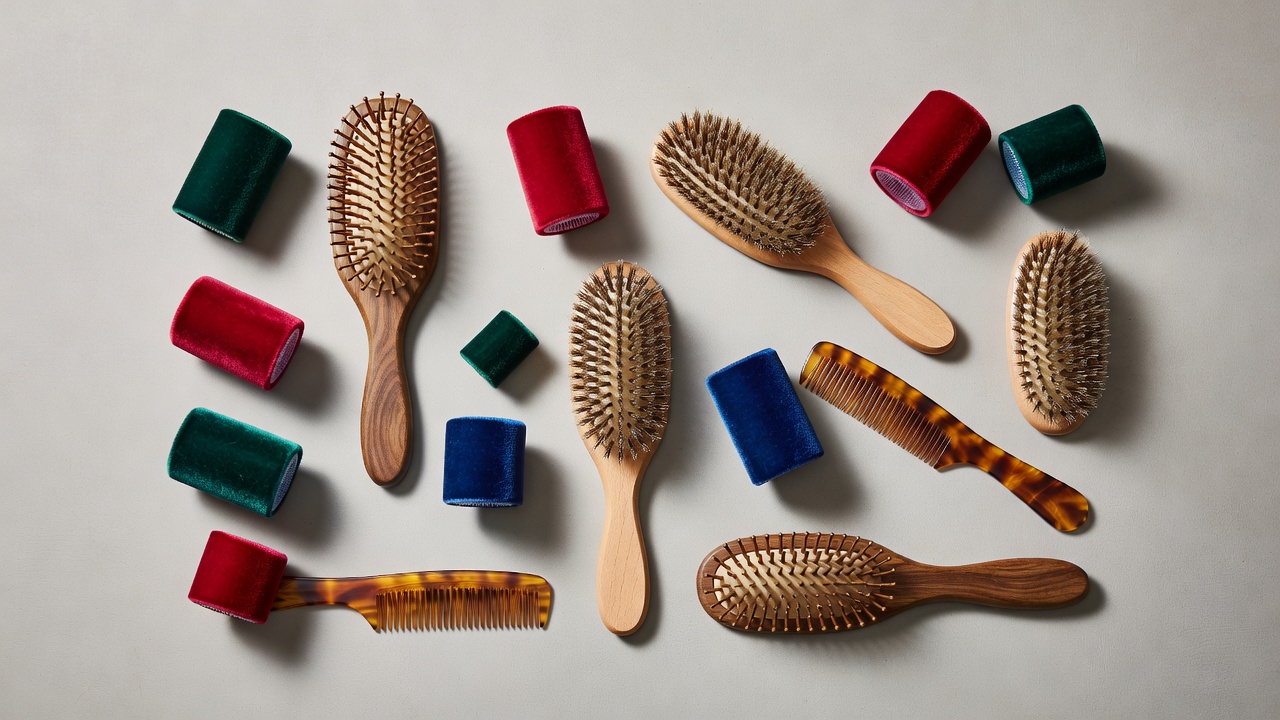
Brushes do far more than remove knots; they govern how individual hairs group together. When bristles are closely packed—as in a classic Mason Pearson-style boar bristle pad—they spread scalp lipids down the shaft and merge separated curls into sleek, continuous waves. When pins are set in staggered, wide-spaced rows inside a heavy rubber pad—such as the classic Denman D3 or D4 geometry—they act like a gentle ribbon-curler on soaking-wet hair.
Vented Curved Brushes vs. Cushion Paddle Brushes
If you use low-warmth airflow to speed up drying, a curved vented brush with flexible teeth (similar to the Olivia Garden or Wet Brush Speed Dry architecture) lets air pass right through the spine so moisture evaporates without baking the hair against a solid ceramic cylinder. By contrast, a flat pneumatic cushion paddle brush is best kept for dry detangling before bed or smoothing out an overnight silk-ribbon set.
circumference & grip
2. Rollers and Heat-Free Wrapping Rods
Rollers create architectural lift at the root that no flat iron can imitate, because they hold the base of the hair strand at an elevated angle while the hydrogen bonds cool or dry. Choosing the right roller comes down to when you plan to wear it—during a thirty-minute morning routine or across seven hours of sleep.
morning volume • 20–35 mins
Flocked Velvet & Magnetic Rollers
Smooth plastic magnetic rollers (used wet in traditional salon sets) and velvet-flocked rollers provide high shine because the hair lies flat against a non-hooked cylinder. Secure them at the base with stainless steel duckbill clips or curved roller pins.
ideal for: fine to medium strands
overnight comfort • 6–8 hours
Satin Foam Rods & Flexi-Rods
Traditional bare-foam rollers absorb moisture and create frizz. Modern mulberry silk or satin-covered curling ribbons and smooth rubberized flexi-rods bend comfortably against a pillow while keeping the hair cuticle sealed and smooth.
ideal for: medium to long lengths
quick root lift • 15–25 mins
Jumbo Self-Grip Crown Rollers
Best reserved for the top three or four sections along the part line when hair is 90% dry. Always unroll them outward like unfurling a carpet—never slide them sideways off the ends.
ideal for: curtain bangs & crown lift
airflow & sectioning
3. Diffuser Bowls and Sectioning Accessories
Not all diffuser attachments behave alike. Compact, flat-faced diffusers often push curls outward and create halo frizz. A deep-cupped diffuser with long, vented prongs (such as the Bellissima Diffon style or universal deep-orchid bowls) cradles large sections of hair so the airflow circulates around the curl clump rather than blowing it apart.
Pair your kit with creaseless cellulose acetate clips for holding bangs while they cool, and carbon-antistatic pintail combs for clean, zig-zag or curved partings that prevent your rollers from leaving visible seams.